
Porn Literacy?

The New York Times published this article that Will be useful for sharing with my Media Literacy for Youth students – What Teenagers Are Learning From Online Porn: American adolescents watch much more pornography than their parents know — and it’s shaping their ideas about pleasure, power and intimacy. Can they be taught to see it more critically?

But I have real questions about the way the article is constructed. They don’t interview any girls directly. The entire focus of the early part of the article is about teenage boys, what they are learning, and what they think girls are learning, and how it impacts their expectations about what girls want and will do. And it specifically notes that they are scared to ask girls. The fact that the reporter didn’t interview any teenage girls gives the sense that maybe they are too.

Using Super Bowl Commercials

Next week in the Media Literacy for Youth class, we will be talking about video literacy. So I am giving my students space to provide feedback on yesterday’s Super Bowl ads and to share critiques they find online that they want to share. The goal will be to discuss how we raise youth awareness of these critiques, but also how we involve young people in crafting their own critiques.

For my part, I am sharing this critique of the Dodge Ram commercial from vox.com: Dodge uses Martin Luther King’s anticapitalist sermon to sell pickup trucks, which is especially problematic and discussion-worthy given the unquoted content of the same speech:

“And so we see it everywhere, this quest for recognition. And we join things, overjoin really, that we think that we will find that recognition in. Now the presence of this instinct explains why we are so often taken by advertisers. You know, those gentlemen of massive verbal persuasion. And they have a way of saying things to you that kind of gets you into buying. In order to be a man of distinction, you must drink this whiskey. In order to make your neighbors envious, you must drive this type of car. In order to be lovely to love you must wear this kind of lipstick or this kind of perfume. And you know, before you know it, you’re just buying that stuff. That’s the way the advertisers do it.”

John promotes reading again

When people ask me what my dissertation is about, it’s always handy to have tweets like this to show them.

reading_tweet.PNG

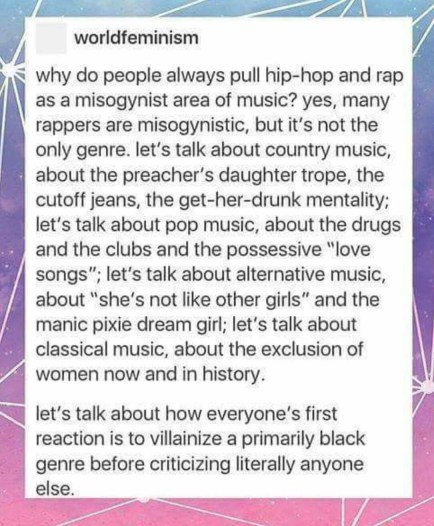
Music Literacy and Race

A friend shared this to my Facebook feed just in time for the discussion of music literacy in my Media Literacy for Youth class next week. I’ve shared it with my students as a way to get them thinking ahead of time about intersectionality and media literacy. When we teach young people the tools to critique and analyze media, what assumptions about race, gender, sexuality, etc. do we possibly reinforce (even inadvertently)? How do we become more aware of our own biases and counter them when modeling media literacy practices?

IMG_5569 (1).JPG

The visuals of TIME’s Person of the Year

I can’t help but find it interesting that when you share the story via the online article onto social media feeds, Tarana Burke is featured (even though Taylor Swift is at the center). And yet the cover of the physical magazine does not feature Burke at all (or McGowan for that matter). It’s only Swift who appears in visual headline of both spaces.

(Seriously, the concept is fabulous and well-appreciated – but there are so many things to parse about the visual construction of this piece, especially across multiple media formats and platforms.)

women of the year.PNG